Mitski - Nothing's About To Happen To Me
By Grace Gongoleski·May 11, 2026
Listening to a Mitski album in full can be a daunting, but rewarding, task. For me, putting on a Mitski album is often a way to ensure my day is emotionally ruined, so I was prepared for this album to do the same. However, after extensive listening to Nothing’s About to Happen to Me, I honestly feel fine. In fact, I don’t feel very moved at all. Though the album is a clear display of well-read musicianship, Miski’s new album lacks some emotional depth and sonic intrigue, assimilating into the general air of indie rock rather than transcending it.
Nothing’s About to Happen to Me marks Mitski’s eighth studio album and third album since announcing an indefinite hiatus from music in 2019. She wasn’t able to stay away from music for too long, releasing Laurel Hell in 2022 and taking on many other projects, including a concert film and writing the score for a musical adaptation of “The Queen’s Gambit”. Music is clearly still a prolific outlet for Mitski.
Mitski introduced the album with the single “Where’s My Phone,” a typical Mitski guitar banger that explores the phone as an escape from reality. Its slightly upbeat tempo help set an angry tone that is seldom found on the rest of the album. On this track, Mitski repeats a desire for her “mind to be a clear glass”, expressing a willingness to self-medicate by immersing herself in a digital world. The song illuminates the depressing reality of a fragmented, digitized world. This isn’t the first time Mitski has expressed her thoughts on phones, albeit not in song form. In 2022, she released a statement on Twitter expressing her disdain for the disconnect created by using phones during live concerts. She explains that when she sees people recording “entire songs or whole sets” it makes her “feel as though we are not here together.” On “Where’s My Phone,” she points out this dependence on phones and their potential to depersonalize and desensitize us from the world proper.
The other single, “I’ll Change for You” is jazzy with a Laufey-esque bossa nova flair. By now, this may be a sound her audience is already acquainted with, but it is a new sound for Mitski. In this, she boldly proclaims “I’ll do anything / For you to love me again”. She states things women may think, but aren’t allowed to say, out of fear of being perceived as pathetic. While she isn’t offering space for her audience to grow, she’s creating a space for them to be seen. There’s often a pressure or advice for women to be strong or angry after a breakup or falling out. However, in actuality, one may feel like the only way to initially heal this pain is to get the other person back. “I’ll Change For You” doesn’t disparage the notion of an independent woman, but expands it by not placing women in a single box, acknowledging and validating all sides of emotion.
However, this album isn’t necessarily depicting Mitski’s personal emotions, thoughts, and experiences. Mitski doesn’t let us into her own mind, but rather a fictitious world following a fictitious character, a “reclusive woman in an unkempt house”. Viewing this album as a concept rather than a personal reflection adds a sense of irony to the lyrics. But this concept of a woman spiraling while stuck yearning for something unattainable seems a little too close to her past work, and doesn’t seem inventive enough to be labeled as a whole concept. Without the outside explanation of the album from Mitski herself, this concept wouldn’t come across at all. It would simply seem like we are being let into Mitski’s own house. The lyrics, as is typical with Mitski, are often about the abjection of being in love: “If I leave, someone else will love you,” the speaker states plainly in the song “If I Leave.” No one else can understand her or love her quite like her lover, but it’s unclear if these should be taken as genuine feelings, or simply the feelings of a crazed woman, slowly losing touch with reality. Should a listener relate to and feel seen by these lyrics? Or should they instead take them as a warning, a precaution against pathetic devotion?
The overall sound of the album mirrors the domestic solitude of the lyrics. Songs like “In a Lake” feature banjo, accordion, and acoustic guitar, constructing a country sound that recalls a rural small-town ambiance. Much of the album utilizes elements of a clean-toned bendy guitar, further adding to the country sound. But Mitski is far from the first indie musician to pull inspiration from folk and country influences–even her previous album, The Land is Inhospitable and So Are We, contained country elements. Now, alternative country is gaining traction; artists such as Waxahachee, This is Lorelei, and MJ Lenderman, are among the many modern indie rock artists with a country folk flair. And this alt-country sound is really just pulling from the playbook of artists like Wilco and Modest Mouse, who pioneered the modern genre. Moving in this direction and pulling from country folk influences seemed like the conventional and safe choice, words that one may not often associate with Mitski.
In fact, the country sound makes some of the songs within the album difficult to tell apart. While the sound is very pretty and often cinematic, the lyrics get lost in the perfect layers, and Mitski’s voice become an indiscernible instrument in the mix of many. The meandering guitar and persistent percussion on “Cats” and “Instead of Here” do little to differentiate these songs from the rest of the album; they undersell the poetic pacing and content of Mitski’s lyricism. On Nothing’s About to Happen to Me, Mitski mellows out and cycles through old sounds rather than innovating.
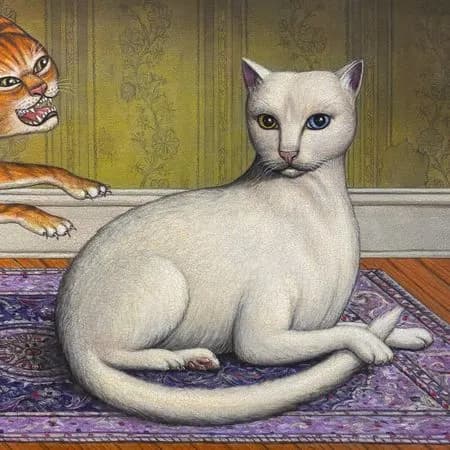
Maybe one of the more adventurous songs on the album is “Rules”, with its saxophone solo and cheeky lyrics where she lists off rules to get over a lover, Dua Lipa-style. And there are moments where she does transcend this feeling of pathetic love, exploring ideas of comfort in anonymity in “In a Lake,” communion with nature on “That White Cat,” and desensitization in “Where’s My Phone.” But a majority of the album is centered around a sense of helpless desire, wanting someone when the feeling isn’t reciprocated.
This theme does appeal to her audience, though. And though maybe she hasn’t grown sonically, she still creates a space for her audience to relate, though the sentiment feels less genuine this time. While she does fully capture the progression and essence of a woman driven mad and stuck in a house, she hasn’t demonstrated much musical or thematic growth, stunting herself in a cycle of self-loathing. This is a well-written album: by any other artist, it would be a strong showing. But within the context of Mitski’s past work, Nothing’s About to Happen to Me is slightly boring, lacking the emotional variety and risk that’s present on her other albums.